Download Ebook OpenGL Data Visualization Cookbook
After waiting on some moments, finally we can offer OpenGL Data Visualization Cookbook in this internet site. This is one of guides that mostly most waited and also desired. Investing more times to wait on this book will certainly not be issue. You will certainly likewise locate the right way to verify how many individuals talk about this book. After the introducing, this publication can be found in numerous sources.
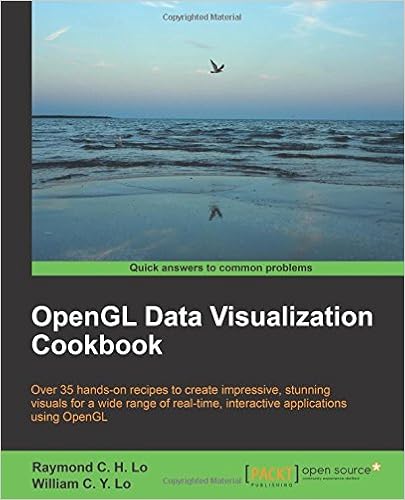
OpenGL Data Visualization Cookbook

Download Ebook OpenGL Data Visualization Cookbook
After so long time no see as well as discover an exceptional publication, currently we are coming. Supplying the excellent publications become our works on a daily basis. We will share whatever regarding the compassion as well as finest of the books. This is not just guides from this nation. The over boarded book collections are likewise numerous to seek for. You won't have to seek for other places; this site is the best readied to locate all book collections.
If you truly would like to know the ways of getting this book, you could follow to read this sales letter. In this instance, OpenGL Data Visualization Cookbook is just one of the items that we provide. There are still lots of books from numerous countries, numerous writers with remarkable floor tiles. They are all offered in the links for obtaining the soft file of each book. So it's so easy to provide the amazing attributes of perfections.
Reviewing will make basic means and also it's not tight adequate to do. You will have recent book to review in fact, yet if you really feel tired of it you can continuously obtain the OpenGL Data Visualization Cookbook From the OpenGL Data Visualization Cookbook, we will remain to provide you the very best book collection. When the book reads in the leisure, you could enjoy exactly how exactly this book is for. Yeah, while somebody wish to obtain ease of reviewing some books, you have actually located it.
Finding this OpenGL Data Visualization Cookbook as the best book really makes you really feel relieved. Even this is simply a book; you can discover some goodness that can't be obtained from other sources. Meeting the curious it is at some point really easy, yet sometime it needs the huge initiative. As below, before finding this internet site to obtain guide, you may really feel so overwhelmed. Why? It's since you truly need this awesome publication to review asap.
About the Author
Raymond C. H. Lo Raymond C. H. Lo is currently the CTO and cofounder of Meta (http://www.getameta.com), a company in Silicon Valley that is creating the world's first augmented reality eyeglasses with 3D gesture input and 3D stereoscopic display. This next-generation wearable computing technology, which is the result of his PhD research, has been featured extensively in news media, including CNN, MIT News, CNET, and Forbes magazine. During his PhD, Raymond worked with Professor Steve Mann, who is widely recognized as the father of wearable computing. Together, they published and presented papers at leading conferences, including the SIGGRAPH and IEEE conferences, on real-time high-dynamic-range (HDR) imaging, augmented reality, and digital eyeglasses, which involve high-performance computation using CUDA and visualization using OpenGL.
Read more
Product details
Paperback: 298 pages
Publisher: Packt Publishing - ebooks Account (August 24, 2015)
Language: English
ISBN-10: 1782169725
ISBN-13: 978-1782169727
Product Dimensions:
7.5 x 0.7 x 9.2 inches
Shipping Weight: 12.6 ounces (View shipping rates and policies)
Average Customer Review:
4.4 out of 5 stars
5 customer reviews
Amazon Best Sellers Rank:
#2,077,934 in Books (See Top 100 in Books)
Good material however riddled with minor errors and the errata will not help you. I absolutely recommend you follow along with the book's source code, which will require you to create an account on the publisher's website.
This is an excellent book that gets you up and running quickly on OpenGL including the fixed function pipeline (version 2), shaders (version 3) and embedded systems/Android (ES). I appreciated the coverage on various platforms (Android, Linux, Mac, Windows) as I was able to use on Ubuntu 15.04, Windows 7/10, and Yosemite.The code depends on several open source libraries that jump start the projects to quickly see the reward for the effort. More importantly, the authors clearly explain why they are taking on the dependencies (GLEW for managing OpenGL extensions, GLFW for windowing, GLM for matrix math, SOIL for handling graphics formats, and OpenCV for imaging), I think most of these have fairly permissible licenses so you should be able to re-use without much concern (but I am an engineer and not a lawyer).The content is in tutorial format so it is a good first read for someone starting with OpenGL without having to search across multiple web sites. You will want to have a good reference with you to satisfy any curiosities about API calls.I was impressed with the examples that were more interesting than the standard tea pot and simple triangle renderings. Most of the content is generated programmatically through solution of math problems. While the math can be fairly sophisticated, the problems were focused on medicine and I found them relatable despite the fact that medicine is not my principle area of study (but I have a heart beat and the authors take the time to provide background information on what a heart beat plot should look like that was quite interesting).Anyway, the recipes in the cookbook are related to computer imaging of data based on various mathematical models. You start by drawing a simple sine curve on a 2D plot and progress to 3D contour plots. Then, you will start integrating filters for image processing. There is also a recipe for working with the Microsoft Kinect 3D range sensing camera on Apple, Linux and Windows platforms. After that, there are recipes for rendering stereoscopic images but I did not have the hardware to test the images.Overall, I am extremely pleased with the book as it quickly started my development across several platforms and saved me time and effort otherwise spent reading various web pages.I struggle to find any criticism. It would be nice to have a recipe for selecting objects (perhaps polygons) with mouse clicks. You also will not find any iOS coverage (at least I did not come across any). Hope this will be in the second edition.
[Disclosure: I am the Technical Reviewer on this book]"OpenGL Data Visualization Cookbook" is filled with excellent real-world examples which are easy to understand and implement. Having a basic-level knowledge of C/C++ will go a long way as we traverse the examples and source code included with the book.Variety of different visualization techniques as well as examples have been provided, the reader will be able to customize a part of code, to better understand the working of individual components.My personal favorite chapter 6 introduces concepts related to stereoscopic 3D rendering techniques and its implementation in OpenGL, for beginners the concept is usually helpful if you are modelling an object lets say customizing a car, you can view and manipulate the 3D model, to have a clear direction of the end product.As mentioned in earlier reviews, most of the libraries mentioned in the book are open source and easy to obtain with instructions mentioned in the book.One of the other pains that the author has took, is providing instructions for complete setup in different operating systems available, so its windows/mac/linux, we wont have much trouble implementing the source code and solutions provided in the book.An implementation of OpenGL on mobile platforms (android) is also included which makes us understand the concept from a different angle.Overall, "OpenGL data visualization cookbook" is structured well, the contents are concise to the point, nothing extra, nothing less and I`m positive about the reader experience in finding it useful.
A very good book that covers 2D and 3D data visualization using OpenGL and other libraries, with setup instructions provided for developing applications for Windows, Linux, Mac and Android platforms.The recipes provides in the book start with the basics, with rendering a rotating triangle and progressively move on to more advanced examples, including:- a 2D electrocardiogram,- interactively visualizing complex 3D data sets,- rendering 2D images and videos with texture mapping and working with OpenCV libraries,- working with GLSL,- real-time video rendering with filters,- rendering 3D point cloud data,- rendering stereoscopic 3D models,- creating augmented reality applications.
Very interesting read. It nicely complement other OpenGL books as it focus exclusively on data visualization. Indeed this is one of the few books I am aware of dealing with this topic using OpenGL.Another good point is given by the accompanying demo source code which runs on my platform of choice (Linux), unlike many other OpenGL books leaning more towards Windows.In summary, if you are interested in data visualization and you already know enough of OpenGL, this book is worth the money.
OpenGL Data Visualization Cookbook PDF
OpenGL Data Visualization Cookbook EPub
OpenGL Data Visualization Cookbook Doc
OpenGL Data Visualization Cookbook iBooks
OpenGL Data Visualization Cookbook rtf
OpenGL Data Visualization Cookbook Mobipocket
OpenGL Data Visualization Cookbook Kindle
0 comments :
Post a Comment